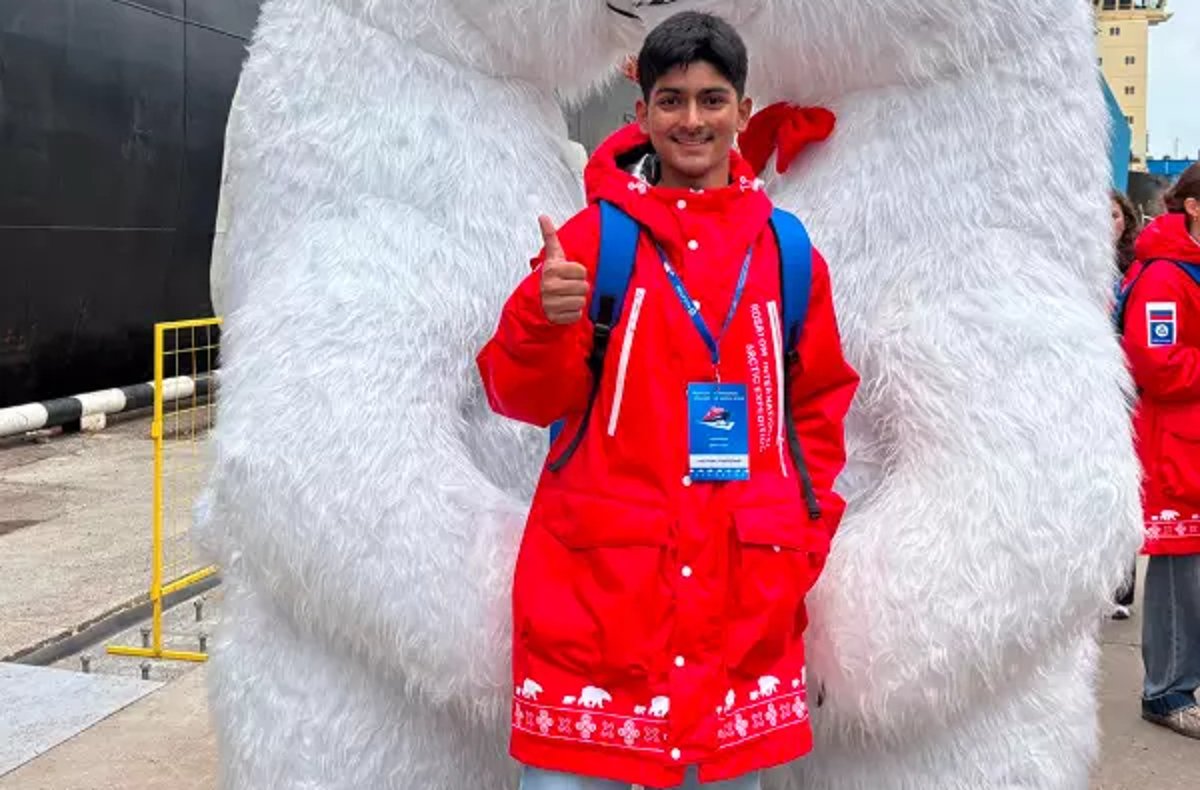
DEHRADUN/CHAKRATA: In a major boost for Uttarakhand’s young talent, Lucky Rawat of Chakrata in Dehradun district has been selected to represent India on the prestigious ‘Icebreaker of Knowledge’ expedition to the North Pole. The 10-day international scientific and educational programme has brought together outstanding students from across the world, offering them a rare opportunity to travel to one of the most inaccessible places on Earth while participating in science-based learning and cultural exchange.
Lucky’s selection makes him India’s representative on the expedition, an honour that places him among a select group of students chosen from 22 participating countries. The journey, which commenced from Murmansk, Russia, is being undertaken aboard the nuclear-powered icebreaker 50 Let Pobedy, carrying participants to the geographic North Pole (90° North latitude), one of the planet’s most remote destinations.
The expedition has assembled students between 14 and 16 years of age from countries including India, Bangladesh, China and Russia, creating an international platform where young minds can interact, exchange ideas and deepen their understanding of science, the environment and global cooperation. Throughout the programme, participants will engage in educational activities, scientific discussions and cultural interactions designed to encourage curiosity, innovation and cross-cultural understanding.
For Lucky Rawat, the expedition represents far more than an overseas educational visit. It is an opportunity to represent India before an international audience while learning alongside some of the brightest young students from different parts of the world. The experience is expected to expose participants to scientific concepts related to the Arctic region and provide firsthand insight into one of the Earth’s most unique ecosystems.
Speaking about the achievement, Lucky expressed pride at being selected to represent the country on such a prestigious international platform. Introducing himself as a student from Chakrata in Uttarakhand, he described the opportunity as a matter of great honour and responsibility.
“I am from Chakrata in Uttarakhand and have come here as India’s ambassador for this expedition. It is a 10-day expedition during which we will travel to the North Pole. We will be among the very few people who have actually reached the North Pole,” he said.
His remarks reflected both excitement and a sense of responsibility, as only a limited number of people worldwide have had the opportunity to stand at the northernmost point of the Earth. The expedition offers participants a rare experience that remains inaccessible to the vast majority of people because of the Arctic’s extreme climatic conditions and geographical isolation.
Lucky also explained the rigorous selection process that ultimately earned him the opportunity to represent India. According to him, students from participating countries had to undergo a three-stage selection process, designed to assess their abilities before the final representatives were chosen.
The competition involved multiple rounds of evaluation, after which only one student from each participating country was selected. Lucky successfully cleared all three stages to emerge as India’s representative, making him the country’s sole participant in this year’s expedition.
Expressing pride over his son’s achievement, Lucky Rawat’s father, Ram Singh, said the family was delighted that he had earned the opportunity to represent India. “I’m proud of my son for clearing the online examination and being selected to represent India, He is going on a 10-day expedition to the North Pole.” Singh told.
The selection highlights not only his academic capability but also his ability to compete successfully against students from across the country during a demanding evaluation process. His achievement has drawn attention to the talent emerging from Uttarakhand’s hill regions and has become a source of pride for his hometown of Chakrata.
The Icebreaker of Knowledge programme is recognised as an international educational initiative that combines scientific learning with practical exposure. Rather than functioning as a conventional sightseeing tour, the expedition focuses on education and collaboration, allowing students to explore scientific themes while travelling through the Arctic aboard one of the world’s most powerful nuclear icebreakers.
During the 10-day voyage, participants are expected to take part in science-oriented educational sessions and collaborative activities designed to broaden their understanding of subjects related to the polar environment. The programme also includes cultural exchange initiatives that encourage interaction among students representing different nations and backgrounds.
The opportunity to travel aboard the 50 Let Pobedy adds a unique dimension to the expedition. The vessel, a nuclear-powered icebreaker, is specially designed to navigate through the thick Arctic ice that covers the waters leading to the North Pole. Such ships play a crucial role in enabling scientific missions and educational expeditions to reach areas that are otherwise inaccessible through conventional maritime transport.
The geographic North Pole, located at 90 degrees North latitude, is one of the most isolated places on Earth. Unlike inhabited regions, the North Pole consists of floating sea ice covering the Arctic Ocean, making access extremely limited and dependent upon specialised vessels capable of breaking through dense layers of ice. Consequently, only a relatively small number of explorers, researchers and expedition participants have ever reached the location.
Lucky’s observation that participants would become “among the very few people” to visit the North Pole reflects the rarity of such expeditions. For young students, the programme offers not only a memorable journey but also a unique educational experience that combines adventure with scientific learning.
The multinational nature of the expedition is another defining feature of the programme. Students from 22 countries are participating this year, providing opportunities for dialogue across cultures and nationalities. Through shared educational activities, participants are expected to develop friendships, exchange perspectives and gain greater appreciation of global cooperation in science and education.
Such international interactions are considered an important component of the programme, encouraging students to appreciate cultural diversity while working together on educational activities. The initiative aims to create a collaborative environment where participants learn not only from experts but also from one another.
For India, Lucky’s participation ensures representation in a programme that brings together talented young students from multiple countries. His selection demonstrates the ability of Indian students to compete successfully in international educational initiatives and underscores the growing participation of Indian youth in global scientific and academic programmes.
For Uttarakhand, the achievement carries additional significance. Chakrata, a picturesque hill town known primarily for its natural beauty and strategic location, has now produced a student who will represent the country on one of the world’s most extraordinary educational expeditions. The accomplishment has generated pride not only for the student’s family but also for the wider community.
Educational achievements of this nature often serve as inspiration for other students, particularly those studying in smaller towns and rural regions. Lucky’s journey illustrates that opportunities at the international level are accessible through dedication, perseverance and success in competitive selection processes.
His success also highlights the importance of encouraging young students to participate in programmes that extend beyond conventional classroom education. Exposure to international educational initiatives enables students to develop broader perspectives, engage with emerging scientific ideas and build connections with peers from different countries.
The North Pole expedition represents a unique blend of science, education and international cooperation. By bringing together students from diverse cultural and educational backgrounds, the programme seeks to encourage curiosity, scientific thinking and collaborative learning among future generations.
As the expedition progresses through the Arctic, Lucky Rawat will carry with him not only the aspirations of his hometown in Uttarakhand but also the responsibility of representing India before an international community of young learners. His participation stands as a significant personal milestone and an inspiring example of how determination and academic excellence can open doors to extraordinary opportunities on the global stage.
With the voyage underway from Murmansk towards the geographic North Pole, Lucky has embarked on a journey that few people in the world will ever experience. For the teenager from Chakrata, the expedition marks the beginning of an unforgettable chapter, combining scientific exploration, international friendship and the honour of representing India at the very top of the world.
Dheeraj reports on governance, public services, jobs, and regional developments across Uttarakhand. He specialises in recruitment news, public-sector updates, and civic issues that impact everyday citizens. His reporting brings accuracy, context, and a grassroots perspective to local journalism.