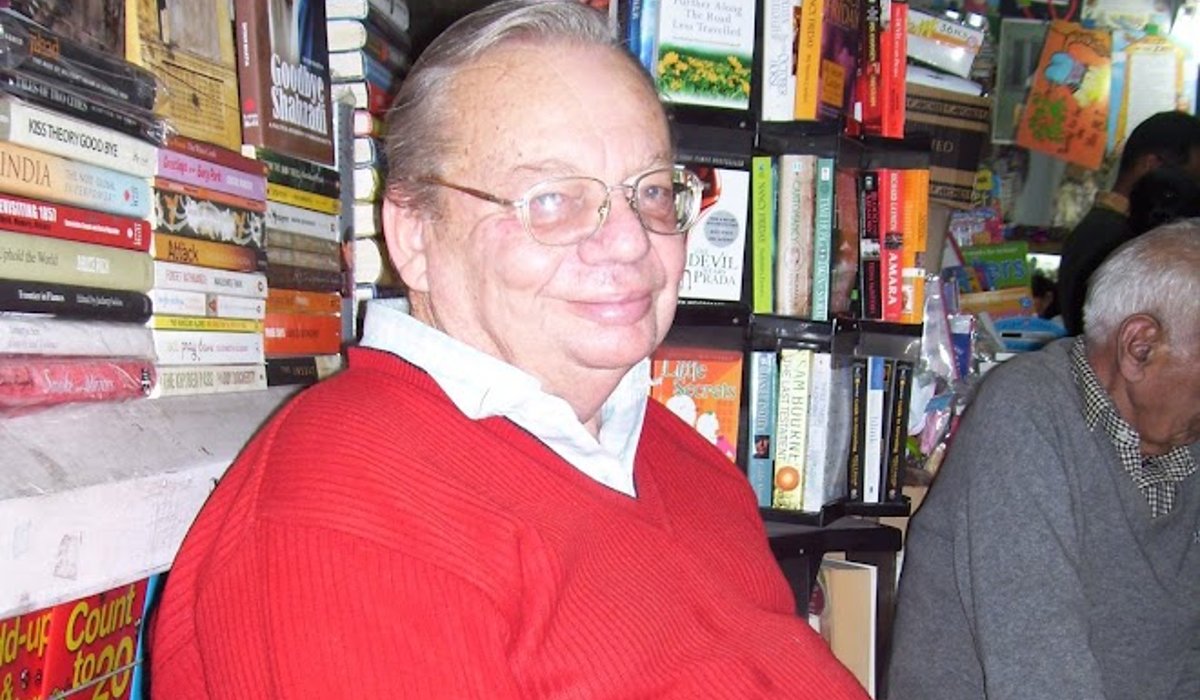
DEHRADUN: In a health-related development, celebrated author Ruskin Bond was hospitalised in the city on Saturday after he experienced discomfort in one of his legs, prompting his family to seek medical attention. Family members said that the author was admitted as a precautionary measure and remained under observation, adding that his condition was stable and he was likely to be discharged soon.
Family sources said that Bond faced difficulty in walking due to weakness in his leg. Doctors advised hospitalisation to conduct routine medical assessments and provide supportive care. His relatives said that there was no cause for immediate concern and that the author responded well to treatment. They said that doctors expected him to return home after completing necessary medical checks.
Bond, who has spent most of his life in the hill town of Mussoorie near Dehradun, remained one of India’s most loved literary figures. Known for his gentle storytelling and deep connection with the Himalayas, he enjoyed a devoted readership across generations. News of his hospitalisation prompted concern among readers, writers and admirers, many of whom shared messages wishing him a speedy recovery.
Born on May 19, 1934, in Kasauli, Ruskin Bond spent his early years moving across different parts of India. His childhood experiences, marked by frequent relocations and a deep sense of observation, later shaped his literary voice. After his schooling, he began writing at a young age and showed remarkable literary promise early in life.
Bond published his first novel, The Room on the Roof, while he was still a teenager. The book portrayed the emotional journey of a young Anglo-Indian boy and reflected themes of identity, belonging and friendship. The novel received widespread recognition and won the John Llewellyn Rhys Prize, establishing Bond as a significant new voice in literature.
Over the decades, Bond built a prolific writing career that spanned novels, short stories, essays, poems and children’s literature. His works often focused on everyday life, small-town experiences, human relationships and the natural beauty of the hills. His writing style remained simple yet evocative, allowing readers to connect deeply with his characters and settings.
Among his most well-known works were The Blue Umbrella, A Flight of Pigeons, Vagrants in the Valley, Delhi Is Not Far and Rain in the Mountains. Many of these stories explored themes of compassion, nostalgia, resilience and quiet joy. Several of his works were later adapted into films and television productions, further expanding his reach beyond literary circles.
Bond wrote extensively for children and young readers, creating stories that balanced innocence with wisdom. His characters often included ordinary people, animals and landscapes, portrayed with warmth and sensitivity. Educators frequently recommended his books in schools, and generations of students grew up reading his stories.
Throughout his career, Bond maintained a close relationship with nature. Living in the hills allowed him to observe seasonal changes, wildlife and village life, all of which featured prominently in his writing. His essays often reflected on solitude, ageing, friendship and the passage of time, themes that resonated deeply with readers.
Despite advancing age, Bond continued to write and interact with readers through letters, essays and public messages. He remained a regular presence in literary festivals and cultural events whenever health permitted. His humility and warmth endeared him not only to readers but also to fellow writers and critics.
In recognition of his contribution to Indian literature, Bond received several national honours. He was awarded the Sahitya Akademi Award for his distinguished literary work. The Government of India later honoured him with the Padma Shri and the Padma Bhushan, acknowledging his lasting impact on Indian writing in English.
At the time of his hospitalisation, Bond was in his nineties and had largely limited his public appearances. Family members said that he continued to enjoy reading, writing and engaging with his surroundings. They said that his hospital admission was precautionary and part of routine care for someone of his age.
Doctors attending to him said that he remained alert and comfortable. Hospital staff confirmed that he received appropriate medical supervision and that his condition showed steady improvement. Family members expressed gratitude for the concern shown by readers and well-wishers across the country.
As news of his health spread, literary circles reflected on Bond’s enduring legacy. Many writers described him as a storyteller who captured the soul of ordinary life with rare simplicity and honesty. Readers continued to revisit his works, sharing memories of stories that shaped their childhood and understanding of the world.
Bond’s hospitalisation once again highlighted the affection he commanded across India. Admirers said that his writings continued to offer comfort, hope and quiet reflection. As he recovered under medical care, readers awaited his return home, confident that his words and stories would continue to inspire for years to come.
Dheeraj reports on governance, public services, jobs, and regional developments across Uttarakhand. He specialises in recruitment news, public-sector updates, and civic issues that impact everyday citizens. His reporting brings accuracy, context, and a grassroots perspective to local journalism.