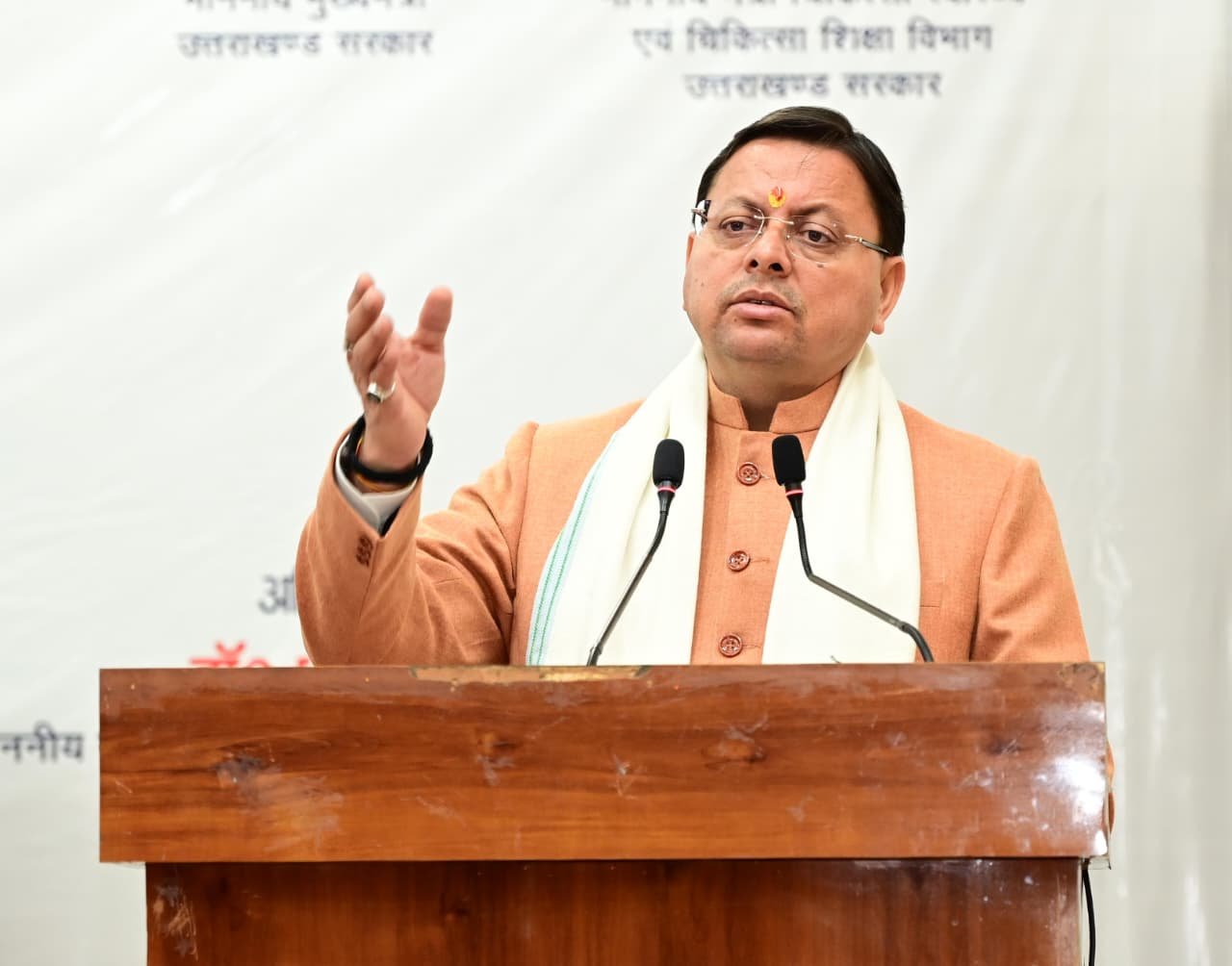
DEHRADUN: The Uttarakhand government on Sunday made the recitation of verses from the Bhagavad Gita mandatory in all government schools across the state, with Chief Minister Pushkar Singh Dhami stating that the initiative (Bhagavad Gita recitation) aims to connect students with Indian culture, moral values and the philosophy of life from an early age.
Announcing the decision, the Chief Minister said the move was part of a broader effort to ensure the holistic development of children by combining academic learning with ethical and cultural education. He said that daily engagement with the teachings of the Bhagavad Gita would help students develop discipline, clarity of thought and a strong moral foundation.
“Our government has made the recitation of verses from the Bhagavad Gita mandatory in the schools of the state,” Dhami said. “This initiative is intended to connect students with Indian culture, moral values and the philosophy of life, which will contribute to their all-round development.”
Under the new directive, all government schools have been instructed to include the recitation of at least one shloka from the Bhagavad Gita during the morning assembly. Teachers will also be required to explain the meaning of the verse in simple language so that students can understand its relevance in daily life.
Our correspondent reports that education department officials said the recitation will not be limited to chanting alone. Emphasis will be placed on helping students grasp the ethical and practical lessons contained in the verses, including concepts such as duty, self-discipline, compassion, perseverance and balanced decision-making.
Officials clarified that the initiative is being introduced as part of value-based education and character building, and not as religious instruction. They said the focus would remain on universal values and life skills that are applicable across communities and belief systems.
The state government has also indicated that elements from Indian epics such as the Ramayana and the Mahabharata may be gradually incorporated into classroom discussions in alignment with the National Education Policy. Education officials said these texts offer examples of leadership, ethical dilemmas, social responsibility and personal integrity that can help students better understand complex real-life situations.
Our correspondent adds that guidelines will soon be issued to schools detailing how the recitation and explanations should be conducted, ensuring uniformity across districts. Teachers may also be provided with reference material and training support to help them present the verses in a contextual and age-appropriate manner.
The decision has generated wide public discussion across the state. Supporters of the initiative have welcomed it as a step towards preserving cultural heritage and strengthening moral education. Many parents and cultural organisations have said that early exposure to classical texts can help children develop emotional stability and ethical awareness in an increasingly competitive and stressful environment.
At the same time, some educators and civil society groups have urged caution, stressing the need to maintain the secular character of government schools. They have called for clear safeguards to ensure that the programme remains inclusive and does not marginalise students from different backgrounds.
Responding to such concerns, government officials said that the emphasis would remain on values and philosophy rather than religious practice. “The teachings of the Bhagavad Gita are universal in nature,” an education department official said. “The focus is on life lessons that encourage responsibility, self-control and respect for others.”
The Chief Minister has consistently highlighted the importance of cultural awareness alongside modern education. In recent remarks, he said that understanding India’s civilisational heritage helps students develop a strong sense of identity while also learning to respect diversity.
Our correspondent reports that Dhami also linked the initiative to Uttarakhand’s identity as a spiritual and cultural centre. He said that the state, often referred to as Devbhoomi, has a responsibility to preserve and pass on its rich philosophical traditions to future generations in a balanced and inclusive manner.
Education experts noted that similar value-based programmes have been introduced in various forms in other states, though implementation remains a key challenge. They stressed that teacher preparedness, classroom time management and sensitivity to student diversity would determine the success of the initiative.
School administrators said they would begin preparations immediately once formal guidelines are issued. Several principals said morning assemblies already include moral teachings and prayers, and the inclusion of Gita verses would be integrated carefully without disrupting academic schedules.
Officials said the education department will monitor the implementation through periodic reviews and feedback from teachers, students and parents. Adjustments may be made based on ground-level experiences to ensure that the initiative adds value to the learning process.
As the directive comes into force, the state government has reiterated that its objective is to create well-rounded individuals who are academically competent, ethically grounded and culturally aware. The Chief Minister said such initiatives are essential to preparing young citizens who can contribute positively to society while remaining rooted in India’s philosophical traditions.
The government said further announcements regarding curriculum enrichment and value-based education reforms may follow in the coming months as part of a larger roadmap for school education in Uttarakhand.
Dheeraj reports on governance, public services, jobs, and regional developments across Uttarakhand. He specialises in recruitment news, public-sector updates, and civic issues that impact everyday citizens. His reporting brings accuracy, context, and a grassroots perspective to local journalism.