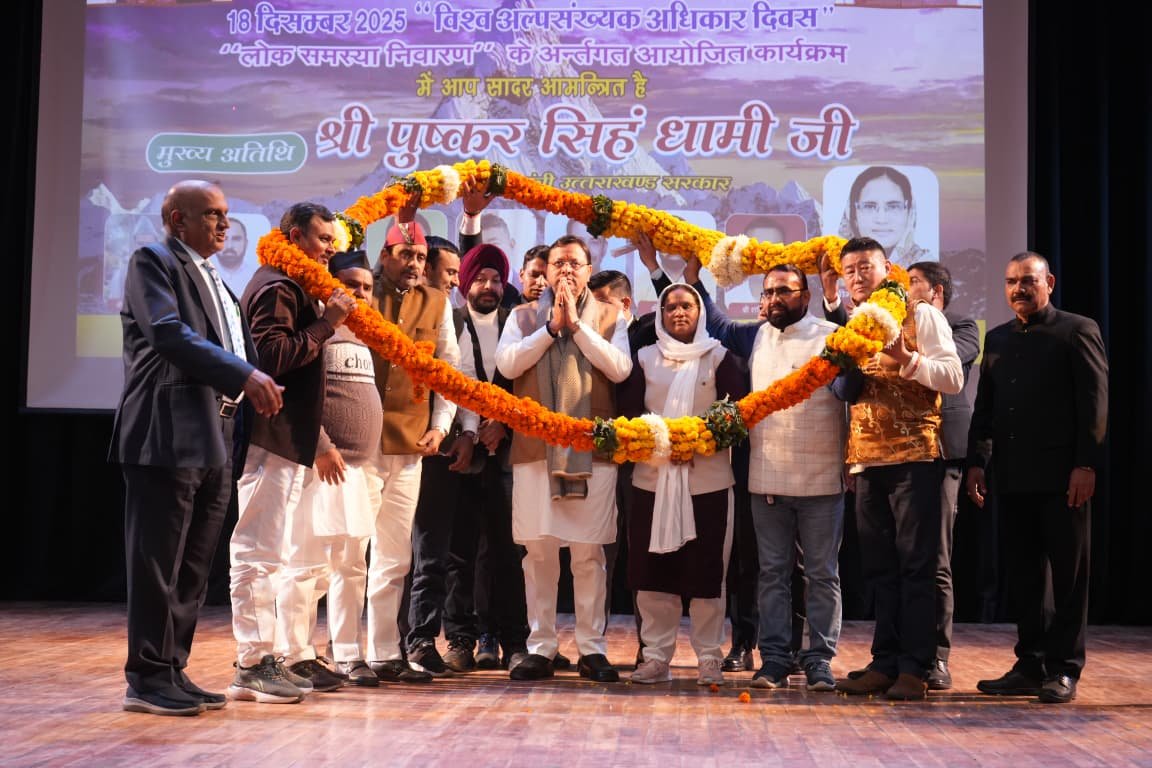
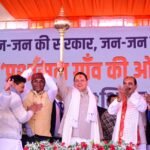
DEHRADUN: Chief Minister Pushkar Singh Dhami on Thursday participated in a programme organised on the occasion of World Minority Rights Day at the Himalayan Cultural Centre in Nimbuwalam, here, where he reiterated the state government’s commitment towards minority welfare, equality, social justice and inclusive development of minority communities. The programme witnessed the participation of representatives from various minority groups and featured exhibitions showcasing welfare initiatives.
Our correspondent reports that during the programme, the Chief Minister honoured meritorious students belonging to minority communities and visited stalls set up by different departments highlighting schemes related to education, skill development and social welfare. Officials said the event aimed to create awareness about government initiatives and reaffirm constitutional values of equality and mutual respect.
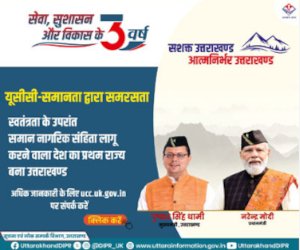
A large number of Muslim women present at the event expressed gratitude to the Chief Minister for the implementation of the Uniform Civil Code in Uttarakhand. They stated that the move would strengthen social justice and ensure equal rights. Responding to their views, the Chief Minister said that the government is continuously working for the welfare of all minority communities through targeted policies and schemes.
Addressing the gathering, Dhami said World Minority Rights Day serves as a reminder of India’s constitutional duties towards unity and integrity. “Today is an opportunity to remember our fundamental duties towards preserving the unity and integrity of the nation,” he said. He highlighted that Indian civilisation has, for centuries, upheld traditions of equality and respect for all religions and communities. Referring to India’s cultural ethos, he said the principle of Vasudhaiva Kutumbakam reflects the country’s belief in viewing the entire world as one family.
Our correspondent adds that the Chief Minister emphasised that diversity has always been India’s strength, despite differences in languages, traditions and food habits. He said the spirit of unity has remained central to the country’s identity and governance.
Dhami further stated that under the leadership of Prime Minister Narendra Modi, the government is working with the guiding principle of “Sabka Saath, Sabka Vikas” to ensure inclusive growth. He cited schemes such as Jan Dhan Yojana, Ujjwala Yojana, PM Awas Yojana and free ration distribution as examples of initiatives that have helped minority communities integrate into the mainstream.
Highlighting national level decisions, the Chief Minister said the construction of the Kartarpur Sahib Corridor, exemption of taxes on langar, the Jiyo Parsi scheme, development of the Buddhist circuit, establishment of Jain study centres, digitalisation of the Haj pilgrimage process and the abolition of the practice of triple talaq were steps taken to safeguard minority rights and dignity.
Our correspondent reports that the Chief Minister also spoke about infrastructure development in minority dominated areas through the Prime Minister’s Minority Development Programme. He said schools, colleges, hostels, ITIs, health centres and skill development institutions are being established to strengthen educational and economic opportunities.
Speaking on reforms, Dhami said amendments to Waqf laws were aimed at ensuring transparency and accountability so that Waqf properties could benefit poor, needy and backward sections of society.
At the state level, the Chief Minister outlined several initiatives, including the Chief Minister Minority Incentive Scheme, pre matric and post matric scholarship programmes, and the Minority Development Fund. He said the fund provides Rs 4 crore annually to promote economic and educational development in minority areas.
Our correspondent adds that the Chief Minister highlighted employment focused schemes such as the Chief Minister Hunar Yojana, minority self employment loans with subsidy, and interest free education loans under the Maulana Azad Education Loan Scheme. He noted that over the past four years, more than Rs 4 crore has been distributed to beneficiaries under the education loan scheme.
Dhami also spoke about the implementation of a new Minority Education Law in Uttarakhand. He said the law ensures quality education for all minority communities, including Sikhs, Christians, Jains, Buddhists, Parsis and Muslims, by mandating both religious education and the state board curriculum in minority institutions.
Referring to the anti conversion law, the Chief Minister said the legislation was introduced to protect religious freedom and prevent conversions through force, inducement or deceit, thereby maintaining social harmony.
On the occasion of World Minority Rights Day, Dhami appealed to minority communities to raise their voices against discrimination and atrocities faced by minorities in several countries. “Minority communities in many parts of the world face discrimination and persecution. It is important to speak against such injustice,” he said.
The programme was attended by Uttarakhand Minority Commission Vice Chairperson Farzana Begum, Padma Shri awardee Dr R K Jain, Hemkund Sahib Trust Chairman Narendrajit Singh Bindra, Waqf Board Chairman Shadab Shams and other dignitaries.
Officials said the event reflected the government’s emphasis on dialogue, inclusion and participatory governance while reaffirming its commitment to protecting minority rights within the constitutional framework.
Dheeraj reports on governance, public services, jobs, and regional developments across Uttarakhand. He specialises in recruitment news, public-sector updates, and civic issues that impact everyday citizens. His reporting brings accuracy, context, and a grassroots perspective to local journalism.