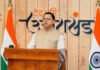
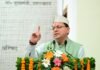
HARIDWAR: Chief Minister Pushkar Singh Dhami on Monday announced that the government will establish a high-level commission dedicated to the promotion and expansion of Sanskrit education in the state. The announcement came during an international Sanskrit conference held in Haridwar on Monday, where scholars from India and abroad convened to discuss the global relevance of India’s ancient knowledge traditions.
Our correspondent reports that the Chief Minister’s announcement marks one of the most ambitious state-level initiatives for Sanskrit upliftment, aligning with the wider national emphasis on classical languages and traditional knowledge systems.
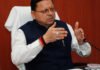
Delivering his address, the Chief Minister said Sanskrit was not merely a language but “a living repository of India’s civilisational brilliance”. He added, “Sanskrit is the foundation of our culture, our philosophical heritage, and our scientific legacy. The new commission will help us strengthen it systematically across schools, universities and research institutions.”
The two-day international conference, themed ‘Indian Knowledge Tradition: Contribution of Sanskrit to Global Intellectual Heritage’, brought together academics, linguists, researchers and students from multiple countries. The discussions centred on classical texts, linguistic frameworks, scientific literature, and the contemporary relevance of Sanskrit.
Reflecting on his own early education, the Chief Minister said, “I studied Sanskrit until Class 9. Even today, I remember the verses, grammar and the unique rhythm of the language. Its precision, depth and scientific structure are unparalleled. My personal connection with Sanskrit inspires me to support its development in every possible way.”
Sanskrit as a global intellectual pillar
During his address, the Chief Minister highlighted that Sanskrit had shaped global linguistic and philosophical traditions. He said, “Many world languages share roots with Sanskrit. Our Vedas, Upanishads, Ayurveda, Yoga, literature, mathematics and astronomy—all were built through this language. It represents the intellectual peak of ancient humanity.”
He further noted that European scholars in the 18th and 19th centuries initiated major global research on Sanskrit, recognising its scientific grammar and rich textual heritage. “From Takshashila and Nalanda to Vikramshila and Vallabhi, Sanskrit-based education shaped world discourse. Thinkers like Aryabhata, Charaka, Sushruta, Panini, and Chanakya emerged from this tradition,” he said.
NEP and modern Sanskrit initiatives
Our correspondent adds that the Chief Minister praised the efforts of the Union Government, noting that the National Education Policy (NEP) recognises Sanskrit as a practical and modern language. “Digital tools, e-learning platforms, mobile apps and online Sanskrit libraries have made the language accessible for the new generation. The recent initiative to translate parliamentary proceedings into Sanskrit is another milestone,” he said.
He cited the example of Mattur in Karnataka as a village where Sanskrit remains part of daily communication, demonstrating its continued vitality.
Uttarakhand’s commitment to Sanskrit revival
The Chief Minister reiterated that Uttarakhand, being a land of sages and Vedic traditions, must take the lead in Sanskrit promotion. “Declaring Sanskrit as the state’s second official language was not symbolic. It reflects our responsibility to preserve a priceless heritage,” he said.
Highlighting government initiatives, he mentioned several schemes:
Gargi Sanskrit Scholarship Scheme provides monthly financial support to girl students in Sanskrit institutions.
Dr Ambedkar Scholarship Scheme offers assistance to SC/ST students studying Sanskrit.
Sanskrit Student Talent Awards honour high-performing students with cash prizes.
Support for Sanskrit University students in both undergraduate and postgraduate programmes.
State-backed conferences, workshops and teacher training through Uttarakhand Sanskrit Academy.
The Chief Minister said the government aims to establish model Sanskrit villages in every district. “This will strengthen community-level engagement and create environments where Sanskrit can thrive as a spoken language,” he said.
Preserving a sacred legacy
Speaking on cultural continuity, the Chief Minister said, “Uttarakhand is the birthplace of Vedic knowledge. Preserving Sanskrit is not merely a government initiative but a sacred responsibility of all citizens. One day, Sanskrit will flourish again not only in religious rituals but also as a language of daily communication.”
The conference also featured participation from former Chief Minister Ramesh Pokhriyal, legislators Adesh Chauhan and Pradeep Batra, India’s External Affairs Secretary Meena Malhotra, senior Sanskrit scholars, and delegations from multiple countries.
With the formation of the high-level Sanskrit commission, the state government aims to create a long-term roadmap linking classical knowledge with education, digital tools, research and global cultural exchange.
Dheeraj reports on governance, public services, jobs, and regional developments across Uttarakhand. He specialises in recruitment news, public-sector updates, and civic issues that impact everyday citizens. His reporting brings accuracy, context, and a grassroots perspective to local journalism.