NEW DELHI: A new policy paper has urged the central government to establish a National Prosthetics Mission to address what it describes as a widening mobility divide in India. The paper, titled “Fixing the Mobility Divide: A Policy Roadmap for Accessible Prosthetic Care in India,” argues that prosthetic care must be treated as a core element of public health, social inclusion and national productivity rather than as a peripheral or charity driven intervention.
Prepared by Parashar Industries in collaboration with the Kailash Kher Foundation, the document was launched in the city before policymakers, government institutions and sector stakeholders. It presents a detailed assessment of the gaps in India’s prosthetic ecosystem and outlines an implementable plan for accessible, affordable and integrated prosthetic care.
According to the paper, India records a high number of amputations each year as a result of road accidents, diabetes, industrial injuries and defence related incidents. Yet, prosthetic care across the country remains uneven and largely concentrated in urban centres. The report stated that costs for advanced prosthetic devices often reach several lakhs of rupees, placing them out of reach for many who require long term support. Insurance coverage remained inconsistent between states and the absence of structured rehabilitation pathways meat that amputees often faced prolonged recovery cycles, the paper observed.
The roadmap stated that without a unified national framework, amputees whether civilians, soldiers or industrial workers are left navigating a fragmented system that does not meet modern standards of accessibility. Thus it proposed that prosthetics should be treated as national infrastructure for human capital in line with the government’s vision for Atmanirbhar Bharat and Viksit Bharat 2047.
Among the key recommendations of the policy paper, is the establishment of a National Prosthetics Mission to coordinate health care delivery, defence rehabilitation, social justice programmes and skill development initiatives. The roadmap further proposed complete integration of prosthetic care under Ayushman Bharat, covering fitting services, follow up support and maintenance. Meanwhile, advocates involved in the study said that such an approach would ensure that income and geography do not determine access to mobility.
The roadmap also supported strengthened indigenous manufacturing through Make in India, MSME participation and innovation clusters. It argued that reducing reliance on imported devices would allow India to create a competitive ecosystem for high quality and affordable prosthetic solutions. In addition, it recommended district level prosthetic and rehabilitation hubs to close the gap between urban and rural access.
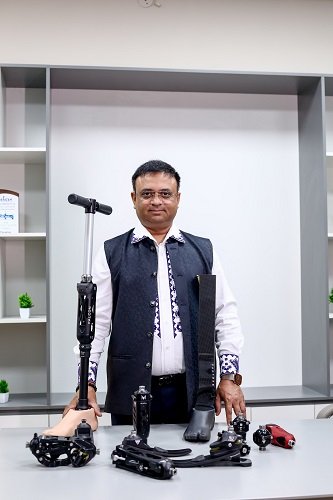
Nagender Parashar, Director, Parashar Industries
Nagender Parashar, Director of Parashar Industries, said the country must adopt a transformative approach to prosthetic care. He said, “Prosthetics are not optional medical devices. They are instruments of dignity and productivity. Every amputee who regains mobility also regains the ability to contribute to the economy and society. A National Prosthetics Mission is not welfare. It is nation building.”
Pilot Neeraj Sehrawat, Chief Strategy Officer at the Kailash Kher Foundation, said access to prosthetics has a direct impact on family stability and social mobility. He said, “Our work on the ground shows that lack of access to prosthetics traps families in cycles of dependency. Integrating prosthetic care into Ayushman Bharat will ensure that no citizen is denied mobility because of income or geography.”
Former Lok Sabha MP Dr Kirit P. Solanki said prosthetic care needs to be placed at the centre of policy thinking. He said, “This roadmap rightly places prosthetics at the centre of public policy by linking health care, indigenous innovation and social justice. Universal access to prosthetic care is essential for an inclusive and progressive India.”
Prof N K Ganguly, former Director General of the Indian Council of Medical Research, highlighted the need for holistic rehabilitation. He said prosthetic care must move beyond delivery of devices to include skilled professionals, strong standards and outcomes based monitoring.
Nitish Sharma, Co founder of PASG Advisory, said the roadmap provides a clear framework for implementation. He said, “Integrating prosthetics with Ayushman Bharat and aligning it with indigenous manufacturing can transform India into a global hub for affordable and advanced prosthetic solutions.”
The policy document also argued that investment in prosthetic care generates long-term economic benefits by restoring livelihoods, reducing welfare dependency and strengthening defence rehabilitation mechanisms. It further stated that a robust prosthetics ecosystem can help India position itself as a leader in inclusive growth and advanced manufacturing.
The roadmap concluded by calling on the government to adopt a decisive approach and recognise prosthetic care as a strategic national priority. It noted that treating prosthetic access as a fundamental enabler of dignity and economic participation is essential for achieving the goals of a developed and equitable India.
Darpita covers business, industry, startups, and economic developments with a focus on Uttarakhand’s emerging markets. She writes on MSME growth, taxation, government policies, and the state’s entrepreneurial ecosystem. Known for simplifying complex financial topics, she aims to make business news accessible and relevant to local readers.
Meanwhile our VUK Business Bureau covers economic developments, policy updates, and market trends with clarity and precision. Focused on delivering in-depth analysis of finance, trade, taxation, and entrepreneurship, the bureau provides readers with reliable insights into how business and economic decisions impact everyday life in Uttarakhand and across India.